Showing posts with label Brown thrasher. Show all posts

Tuesday, August 13, 2019

Flying and figs. . . . . . . . . .


 As I prepared to fly away to New Hampshire, the garden birds continued
 to fly in. . . . . . to the the fig tree which is still producing a lot of fruit. 
Most of the sweet, ripe, juicy figs are up high though and beyond our reach.  

Yesterday while checking the figs I heard a rustling just above my head.
Looking up I saw this beautiful Brown thrasher, a large but somewhat timid 
bird, the size of an American robin, making a meal of the ripe fig. 
We actually made eye contact, then I headed to the house to get my camera, 
never expecting the bird would still be there when I returned, but it was, 
and I managed to get a couple of shots before it flew off.

Special moments in the garden like this make me so happy.


 An American robin also paying a visit to the fig tree recently.


Monday, June 11, 2018

Fare thee well babes. . . . . . . . . . . .


Oh my, how quickly the lovely season of Spring disappears here in the southeast.
The sweet pansies and violas who brought color to the freezing days
 of Winter, then stood tall through springtime in both pots and flower beds,
 (mine actually self-seeded into the beds like magic this year), are just about over
now the days are hot and often very humid.


Carolina chickadee with spider.

Bird life in the garden has been extremely busy this Spring.
Amazing goings on in this hanging Boston fern where the pair of House finches
raised their offspring with the help of a Carolina chickadee, had us glued to the 
dining room window, and me on a step stool every day with a camera!

The three together - can't believe I actually caught a photo of this visit - parent
 finches and the chickadee.


Only two of the four eggs hatched - this was the last baby to leave the nest,
several hours after the first one fledged. The chickadee persuaded it to go,
enticing it out with juicy snacks while the parents were apparently minding the
 other one. The chickadee actually returned for several days afterward as if 
checking on the remaining unhatched eggs, very unusual. 

Finch nest in the hanging Boston fern on front porch.

Brown thrasher watching its nest.

The baby cardinals left their nest in the back garden last week, and I did see one
fly off with its mother but didn't have a camera handy.
We still have another nest with hatchlings in the garden - a Brown thrasher pair built
 a twiggy home in the large privet for their family. They are both busy now bringing
 tasty morsels but because it's just too high - and I don't want to disturb them by putting
 up a ladder - I can't see into the nest so don't know how many babes there are. 

Summer will be here all too soon for me. 
Hot now, much hotter then.
Baby birds will hopefully be sturdy and healthy to deal with the blazing sun.
We'll be traveling north soon where hopefully it will still be much cooler.


Tuesday, July 11, 2017

Birds and their offspring. . . . . . . .


The garden has been exceptionally busy these past few weeks - many new
 family members now learning the ropes regarding eating, bathing and doing
whatever parent birds teach their youngsters. We keep the feeders filled - not cheap
 by any means - however we love our birds. The birdbaths are cleaned and refilled for both
 the birds and squirrels during this hot weather, and to get rid of pesky mosquitoes.


Gray Catbird - Dumetella carolinenis

Handsome slate-gray bird with black crown and long, thin black bill. 
Often seen with tail lifted exposing a chestnut-colored patch, 
just visible here.

This young catbird is busy learning its way around my garden with
 a parent (male and female have same appearance) close at hand
 on the suet feeder.


A secretive bird, the catbird was named 'Bird That Cries With Grief' by
 the Chippewa Indians due to its raspy call.


Brown Thrasher - Toxostoma rufum

A baby Brown thrasher perched on a birdbath considering a drink or
 a dip perhaps. . . . . . . . 

. . . . . . . . while one parent watches from the bench. . . . . . . . .


. . . . . . and the other checks out the food supply!


Again, male and female are identical, a little larger than the American robin,
 with streaked breast, rusty coloring, and yellow eyes. The male has the largest
 documented song repertoire of all North American birds with over 1,100 song types.
This pair have either two or three youngsters - lovely to watch them interact.

I actually parked myself in a chair - with a camera of course - on the back deck
 for a while yesterday morning to watch the busy birds and squirrels.
Guess what? Cute squirrel photos coming next time!

Friday, April 28, 2017

Swim buddies. . . . . . . .


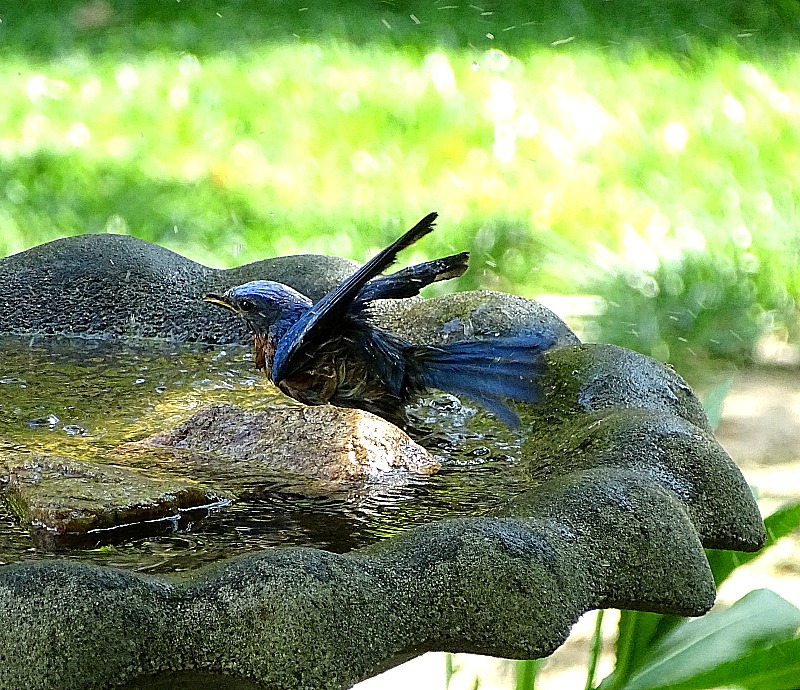
An unusual pair at the swimming hole - the Brown Thrasher and the Eastern Bluebird.


Neither one appeared bothered by the other - don't you love it when people, animals
 and even birds get along together, sharing the same space, attending to their personal
needs, even singing a song whilst doing it.


This is a male bluebird but as the male and female thrashers are identical, 
I'm not sure if this is mixed bathing, or two of the boys getting squeaky clean to
 pursue their respective mates. 
It's that time of year again, the birds are definitely feeling romantic and are
 in nest-building mode.


Bob and I will soon be off on the water ourselves. 
The Mediterranean calls and we're looking forward to the trip
around Sicily and Malta.
My neighbors and family members who stop by will hopefully keep the
 bird baths topped up - with all that splashing the water level soon
drops and bathing becomes difficult for the larger birds.


Monday, March 6, 2017

A big song bird and camellia blooms. . . . . . . . .


A relatively secret bird, the Brown thrasher can be uncooperative in offering
 up its song or the songs of other birds it often mimics. However, when the male does
 let loose, it can display the largest repertoire of any North American bird. . . . .an
 amazing 1,200 songs have been documented!
It usually sings from a perch high in the treetops when hoping to claim a mate, 
and territory. Personally I've only been privy to that amazing concert once, and
 that was several years ago. 
At this time of year, this quite large bird at 11.5 inches in length, stays closer to the
 ground foraging through leaf litter, thrashing its bill from side to side to expose
 spiders and insects - this movement gives it the name 'thrasher'.
Only during winter will it come to feeders, but you can attract it to your garden
with berry-producing plants such as hollies, elderberry, mulberry. . . . . . . . and
of course a water source. A couple of years back a pair nested at eye level in my
 large variegated privet shrub, I loved seeing them closeup.
 Here, my recent visitor tried out two of my back garden baths, and I was able
 to get a few good photos from the window.


Camellia japonica - the Rose of Winter - blooms are profuse this year - I have two
 now quite large bushes in the garden, both this color. Neighbors have beautiful
 pale pink ones - I should get one of those planted too!


Such beautiful markings on the Brown thrasher's chest and wings, plus the gleaming
 yellow eyes. Male and female are similar so not sure which this one is.

If you are within the range of this bird I hope you have them in your garden -
they are fun to watch and perhaps, some day if you're lucky, you'll hear one
 serenading non-stop from a treetop.