Showing posts with label Kenya. Show all posts

Sunday, September 23, 2018

This time two years ago. . . . . .


. . . . . . I was here!

Yesterday, enjoying lovely sunshine in Victoria, British Columbia, I was introduced
 to a lady who is a professional photographer. She was chatting about her 
upcoming first safari trip to South Africa and what camera equipment she might 
require etc. I told her a lot about what to expect and how wonderful it is
to experience close up contact with the wildlife.  

Remembering all those adventures during three exciting safaris,
 reminded me I was there in Kenya at this exact time just two years ago.
I was able to view these animals and birds I photographed, and more. 
Memories are still fresh and will always be here on my blog (hopefully) for me.

Masai Mara, Kenya - September 2016

My blog is my journal - how would I remember all these amazing places
 without being able to look back here and continue to enjoy those trips 
of a lifetime!
Do you ever come back to your blog when you want to recall a 
special occasion, or just want to know where you were or what you
 were doing on a particular day?

Do you consider your blog your journal?

When so many are leaving blogging, do you plan to stay?

Monday, September 11, 2017

Time to pause . . . . . . . .


There are definitely days when I feel it must be
better to be an animal or bird, even a reptile. . . 
. . . not a member of the inhuman race.

Even as we deal with horrendous destruction by
Hurricanes Harvey and Irma, we take time to 
pause on this always heartbreaking anniversary.
We have just watched the annual 9/11 Memorial Service
from Ground Zero in New York City, marking the 
tragedy on this morning sixteen years ago.

We will never forget that day.

All photos from Kenya - September 2016

Wednesday, April 26, 2017

Scribble Picnic. . . . . . . . .Tree


"Trees are poems that the earth writes upon the sky" 
Kahlil Gibran

TREE - quite a simple word for such complexity of form and function.
I'm definitely a tree lover. . . . . and, if totally honest, I guess a bit of a 'tree hugger'
 too. Yes, I might just hug a tree if I thought it was to be cut down or injured for
 no sensible reason.

I've viewed many trees in my travels around the world and it's quite amazing 
how varied they are. I've loved them all, from snow covered swathes of silver birch in
 Kamchatka, Russia, to tropical island palms blowing in Hawaiian breezes.
The towering redwoods I viewed in Northern California last year will never be forgotten.
Billowing pink flowering chestnuts in the Lake District of England, so beautiful.
Mighty ancient oaks and copper beech trees in the forests of my real home in Devon, 
bring back childhood memories of conker fights and nibbling beech nuts as I walked 
through the woods. I have always, yes always, loved the countryside for its trees.
The only place I've visited that lacks trees of any kind is of course 
Antarctica.  Did I miss them and their shades of green, yes of course, but other
 breathtaking land and seascapes brought a different beauty in cobalt blue, 
aquamarine and white to the eye for couple of weeks.

Oh I could definitely bend your ear with tree stories, including a few less loved
 ones that fell on the cottage roof and my car during a couple of infamous
 North Carolina hurricanes. . . . . . . . . but today, for Michael's theme
 for Scribble Picnic I chose to share a lonely tree from Kenya's Masaai Mara.
Please visit this week's participants at the picnic - I'm sure there will be some 
beautiful trees to view by talented artists from around the world.

On last September's safari to that beautiful area of Africa, the animals were 
unbelievable, however I was also struck by the trees. So few scattered
 across the plain, so little shade provided, but sometimes a home to birds who
 wove incredible colonies of hanging nests, whose trunk hid a sleek cheetah waiting
 to make that incredible lightning speed run to grab its meal for the day, and a place
 for the leopard to climb and hang its prey across a branch out of the reach of other
predators, then returning and climbing the tree for several days to eat.

One of several Maasai Mara desert date (Balanites aegyptiaca) trees I
 photographed - here you get the true feeling of how few trees there are. 
Edited to a sketch, with watercolor pencil scribbles for color.

"Keep a green tree in your heart and perhaps a
 singing bird will come"
Chinese proverb

 I'll be away for the next couple of weeks and unable to join the picnic party. 
Internet access on ships is usually sporadic and terribly expensive. I know from
experience that even if you are able to connect, it's so slow and costs a small
 fortune to post anything, especially pictures. I take my laptop really just for
 e-mailing family to keep in touch, and as an additional backup for new
 photos. Sadly I may have to take a short hiatus from blogging. . . . . . 

. . . . . . . but I hope to see you here later in May!


Wednesday, February 15, 2017

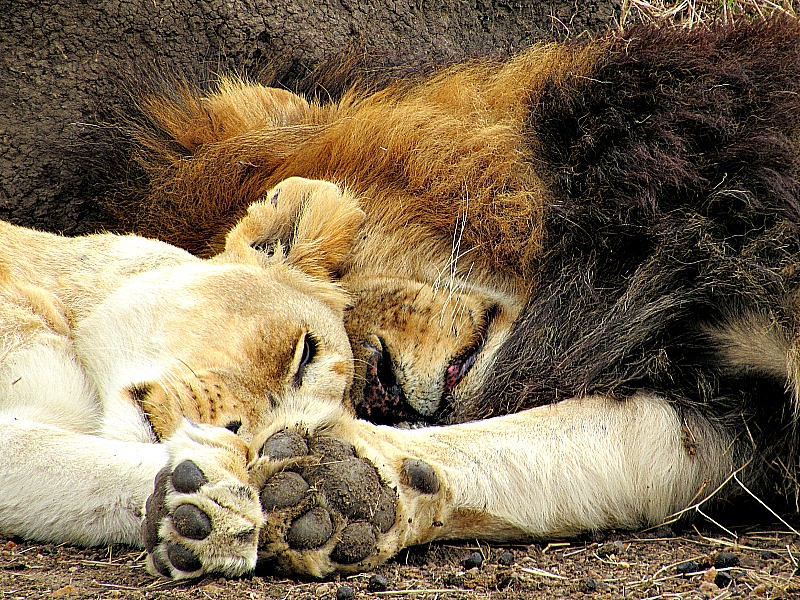
Lions in love---------------------


Masaai Mara, Kenya - September 16, 2016

Early morning on the Mara. Our guide braked as a pair of magnificent lions, 
who were obviously planning a romantic interlude, passed by the safari vehicle.
We followed them quietly for some time - they took us roaming
 with them across the sunny golden plain. 
We even stopped here for our bush breakfast - in a safe spot of course - realizing
 they were in no hurry and we could catch up with them later.
Bob, Tirian - our Masaai guide and friend, Me

When we caught up with them again, he seemed to be treating her well, 
 gently showing affection . . . . . . . . . 


. . . . . . . . he looked at her with adoration


. . . . . . . .and roared, but not at us, at another young male who passed by, possibly
one of his sons according to Tirian.


More snoozing and no action. . . . . . and this continued for quite a while.


So we said goodbye, gave them privacy, and wished them well - they did look happy!

Tuesday, February 7, 2017

Kenyan birdsong. . . . . . .


I'm still sorting through my Kenya photos from the October safari.
I have so many and will eventually need to transfer them to my
 portable drive to free up more storage here on the MacBook.

Today I'm sharing some of my favorite bird photos, all taken with my
bridge Canon Power Shot SX530 HS point and shoot (the one which was just
 repaired after the Thanksgiving gravy spill!). I did not carry the heavy DSLR
 on the trip, and had not yet purchased the Sony Cyber-shot DSC HX400V
 which I'm now using and enjoying immensely.

As well as capturing shots of the mostly beautiful birds captured here, I love
 viewing their resting places and seeing how well some are camouflaged on
 the ground. Vegetation in the Masai Mara area of Kenya is much different from
 what we're used to, especially the often painful looking thorny branches many
 birds seem to pick for preening, mating, singing a song, or searching for the next meal.
Rüppell's Vulture

Bataleur Eagle Pair

African Fish Eagle
Lilac-breasted Roller

Long-tailed Fiscal

Little Bee-eater

Yellow-billed Stork family


Secretarybird

Sharpe's Longclaw
Black-winged Kite


Tawny Eagle


Rüppell's Vulture

Marabou Stork

Although on the ground here, these huge 5 foot tall, 20 pound birds are often
 perched motionless on tree tops, silhouetted against the sky. Prevalent in
 the city of Nairobi, and nicknamed the 'undertaker bird', they appear quite
 terrifying on rooftops. They are scavengers and known to live off human
 garbage and will devour anything from waste tips and slum areas.
They are called "one of the ugliest creatures of the world".
All I can say is that I'm glad they're not in my garden.

Black-and-White Casqued Hornbill


Due to the wide variety of habitats, there are said to be an amazing 470 bird species
 in the Masai Mara Game Reserve - perhaps I need to go back and find a lot more!


Thursday, November 17, 2016

A Morning on the Maasai Mara. . . . . . . . . . . .


Rise and shine!
It's dark with a definite chill in the air.
A stiff breeze billows the linen curtains covering the meshed tent walls.
One almost feels as if floating on a sailing ship.
There's nothing quite like the early morning on Kenya's Maasai Mara.
Your wake-up comes via the 5:30 AM requested delivery of tea, coffee to
hot chocolate at your tent entrance. The Maasai smiles and hands you a tray.
Peering through the canvas it's black as ink outside and the morning noises
 are muffled. A few early birds start to call. China clinks from the nearby kitchen tent,
and fragrant food smells waft through the air.
The monkeys and bush babies who played on your roof through the night are gone.
 The lions have stopped roaring, and hippo grunting has ceased.
By 6:15 AM you are washed (too cold to shower, that comes in the warmer afternoon)
 and warmly dressed. Louder birds call as the hippos slide back into the small
 river behind and below the tent. A tiny lizard runs up the outside
of the canvas walls. You can just make out a line of wildebeest crossing nearby as
the sky shows a narrow line of light on the horizon.
You gather your hat, scarf, day-pack, and most important your camera, flash your
 torch, step outside and zip up your tent flaps. 
Immediately a guard armed with just a machete appears from nearby
 bushes - where he has watched out for your safety through the night - to
accompany you on the short walk to the main tent. There are prints and droppings
 along the soft ground - usually hippo, and once a giraffe, they often visit at night,
 Your friends and guide are waiting. Skipping breakfast, which is there if you want it,
 you know your bush breakfast will be packed in the vehicle ready to enjoy
 when the sun is up and after you've seen some wonderful things. . . . . . . 
such as these. . . . . . . . . .all taken on the morning game drive.


Along the north and east boundaries of the Maasai Mara National Reserve, 
much of the cattle-grazing areas have been converted into wildlife conservancies. 
In these exclusive sanctuaries, the Maasai landowners (each own a small tract of
 unfenced ranch land) now benefit from safari tourism by agreeing to joint land use,
 and lease agreements with safari camp operators who pay their partners an
 annual rent and a daily fee for each visitor.  
Minor troubles aside, the conservancy model has been a huge success for both
 the Maasai landowners and the wildlife which has steadily adjusted, finding more
 safe havens where humans pose only a limited threat and the environment is
 returning to a state of healthy balance.
Conservancies have a limited number of smaller camps which are exclusive to
 their guests. They are permitted to take them into the National Reserve
 however conservancies do not permit safari travelers staying in larger camps
 and lodges to enter conservancies. All of this means more focus on conservation
 and more successful community integration.

Our ten day stay was at the seven tent Mara Plains in the Olare Motorogi
 Conservancy. There the benchmark has been set for sustainable Mara tourism
 in the conservancies, the limit being  just 12 tents per camp and at
 least 3 square kilometers of game viewing land per tent.


By the time the sun is fully risen, life on the Mara is wide awake.
 Driving across the golden landscape, with sweeping views across the plains,
 one felt privileged to be in one of the world's most magnificent wildlife havens. 


Sunday, November 13, 2016

The Crossing -


On a hot afternoon on Kenya's Mara, Tirian, our Maasai guide and friend, maneuvered the hefty safari vehicle into a tiny open spot on the edge of the river bank high above the beached crocodiles. They sunned their 12-15 foot bodies, almost grinning, eyes closed, menacing teeth, their jaws clamped shut whilst waiting. 
We waited too. A couple of hours in the heat, watching for signs, listening for sounds. . . . . . . . would they come, would it happen?


There is no insurance available to guarantee viewing a migration crossing as part of a safari. There is only patience, and of course a great guide who will work diligently to make it part of your visit to the Maasai Mara if you are there at the right time of the year.


It's amazing how quiet these huge animals can be, moving in herds over the bush with barely a sound. Plodding in straight lines one behind the other, giant bulls, mothers with babies, staring ahead or stopping and staring at you!
Nowhere in the world is there a movement of animals as immense as the wildebeest migration. Over two million animals migrate in the search of greener pastures, following the rains which nourish the often completely dry ground.


The annual flow of African animals in the Serengeti-Mara ecosystem is known as the Great Migration. The 1.7 million wildebeest, together with 350,000 Thomson's gazelle, 200,000 zebra and 12,000 eland, make the daring crossings of the Mara River. The exact timing of their progress varies depending on rainfall and sprouting fresh grasses. They usually cross into Kenya around June then make their way around the Mara through July, August and September, before their return to the Serengeti sometime in late September and October. During their time in the Mara the animals have to cross the Mara River where the crocodiles lie in wait for them, an event that is spellbinding, horrifying and spectacular.


On this September afternoon, word was out. Radios crackled, mobile phones rang, Land Rovers and Land Cruisers braked, guides chatted back and forth in languages such as Ma and Swahili. In these photos you can see other safari vehicles vying for a good spot with a view and, before we could steady our cameras, it began. . . . . . . . . 


. . . . . . the wildebeest herd which had been walking past us for a couple of hours, started to cross the Mara River, hippos moved out of the way to the bank, but crocodiles silently slid into the murky water all around.


It's almost impossible to put into words what happened in the following eleven minutes! Yes that's all it took for perhaps close to a thousand wildebeest of all ages and sizes, to cross the narrow river from the flat bank on our side to a mad scramble up the steeper bank on the opposite side!  The movement of the heaving mass of horned bodies through the water turned from brown to gleaming wet pewter, and all the while the huge crocodiles swam about grabbing the smaller animals, drowning them quickly.


At the end there were a few wildebeest still trying to decide whether to cross, but most then turned back. Within minutes all was quiet and it was almost like a dream. The hippos went back to swimming or lounging on the sand, the crocodiles floated down river with their evening meal taken care of. . . . . . . . . . . 


. . . . . . .and when we pulled away from our spot on the bank, almost speechless at what we had just experienced, we were still surrounded by thousands more wildebeest, and this lovely Topi antelope, spread across the golden plain most likely contemplating the greener grass across the river and trying to decide when they would make their crossing during the days to come. In reality there is no single "migration" as the wildebeest have neither a start or finish in their endless search for water and the new green shoots of grass on which they feed. These are quite amazing animals and seeing a crossing was certainly a highlight of our safari.

Where we viewed the migration crossing was several miles from our camp. The long drive back from the river was a time to think about what we had experienced, and we knew how fortunate we were to be there at the right time, thanks to Tirian.

Tirian taking us 'home' to camp . . . . . . . . . 

. . . . . . . and yes, often rough and rocky along the way!


We arrived back around sunset and still the wildebeest herds were moving, silently, all in one direction, through the bush alongside us - another day might see these at the Mara River taking the plunge and heading for greener pastures. It was a day to remember and a privilege to have viewed what many people sadly miss.

Stay tuned, more Africa stories yet to come!