Showing posts with label Safari. Show all posts

Friday, July 16, 2021

Sizing up the cats -


These cute brothers recently moved in with my friend Vanessa - she went
 to adopt one and ended up with two - they are adorable and it's wonderful
 knowing they are staying together. 


I love all cats. On my first safari trip to Africa in 2010 I was amazed to get this
close to the leopard and took many photos of this beautiful boy in Botswana.
 Sitting quietly in the open vehicle I was able to watch him close by in the tree,
and when he climbed down and walked calmly away along the trail he wasn't
bothered by us at all, thankfully!


On a trip to Kenya in 2015, this young male leopard named Twig
 was seen often during our game drives. . . . . . .


. . . . . . . but this morning I'm with Nala, my neighbor's cat. I can tickle her ears, 
and perhaps have a cuddle, always nice!

We are preparing for our first travel away from home since
the start of the pandemic. It feels odd not having packed a suitcase
in so long. I'll keep you posted.

Wednesday, February 15, 2017

Lions in love---------------------


Masaai Mara, Kenya - September 16, 2016

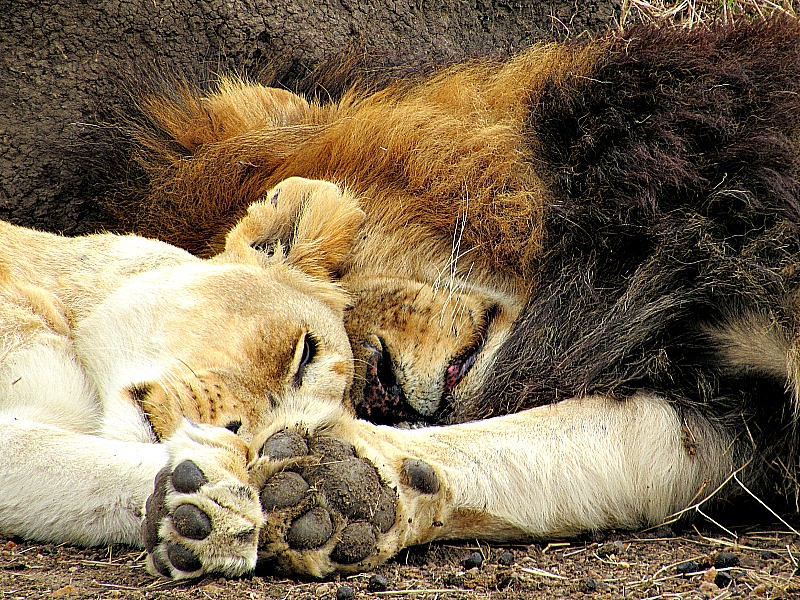
Early morning on the Mara. Our guide braked as a pair of magnificent lions, 
who were obviously planning a romantic interlude, passed by the safari vehicle.
We followed them quietly for some time - they took us roaming
 with them across the sunny golden plain. 
We even stopped here for our bush breakfast - in a safe spot of course - realizing
 they were in no hurry and we could catch up with them later.
Bob, Tirian - our Masaai guide and friend, Me

When we caught up with them again, he seemed to be treating her well, 
 gently showing affection . . . . . . . . . 


. . . . . . . . he looked at her with adoration


. . . . . . . .and roared, but not at us, at another young male who passed by, possibly
one of his sons according to Tirian.


More snoozing and no action. . . . . . and this continued for quite a while.


So we said goodbye, gave them privacy, and wished them well - they did look happy!

Sunday, November 13, 2016

The Crossing -


On a hot afternoon on Kenya's Mara, Tirian, our Maasai guide and friend, maneuvered the hefty safari vehicle into a tiny open spot on the edge of the river bank high above the beached crocodiles. They sunned their 12-15 foot bodies, almost grinning, eyes closed, menacing teeth, their jaws clamped shut whilst waiting. 
We waited too. A couple of hours in the heat, watching for signs, listening for sounds. . . . . . . . would they come, would it happen?


There is no insurance available to guarantee viewing a migration crossing as part of a safari. There is only patience, and of course a great guide who will work diligently to make it part of your visit to the Maasai Mara if you are there at the right time of the year.


It's amazing how quiet these huge animals can be, moving in herds over the bush with barely a sound. Plodding in straight lines one behind the other, giant bulls, mothers with babies, staring ahead or stopping and staring at you!
Nowhere in the world is there a movement of animals as immense as the wildebeest migration. Over two million animals migrate in the search of greener pastures, following the rains which nourish the often completely dry ground.


The annual flow of African animals in the Serengeti-Mara ecosystem is known as the Great Migration. The 1.7 million wildebeest, together with 350,000 Thomson's gazelle, 200,000 zebra and 12,000 eland, make the daring crossings of the Mara River. The exact timing of their progress varies depending on rainfall and sprouting fresh grasses. They usually cross into Kenya around June then make their way around the Mara through July, August and September, before their return to the Serengeti sometime in late September and October. During their time in the Mara the animals have to cross the Mara River where the crocodiles lie in wait for them, an event that is spellbinding, horrifying and spectacular.


On this September afternoon, word was out. Radios crackled, mobile phones rang, Land Rovers and Land Cruisers braked, guides chatted back and forth in languages such as Ma and Swahili. In these photos you can see other safari vehicles vying for a good spot with a view and, before we could steady our cameras, it began. . . . . . . . . 


. . . . . . the wildebeest herd which had been walking past us for a couple of hours, started to cross the Mara River, hippos moved out of the way to the bank, but crocodiles silently slid into the murky water all around.


It's almost impossible to put into words what happened in the following eleven minutes! Yes that's all it took for perhaps close to a thousand wildebeest of all ages and sizes, to cross the narrow river from the flat bank on our side to a mad scramble up the steeper bank on the opposite side!  The movement of the heaving mass of horned bodies through the water turned from brown to gleaming wet pewter, and all the while the huge crocodiles swam about grabbing the smaller animals, drowning them quickly.


At the end there were a few wildebeest still trying to decide whether to cross, but most then turned back. Within minutes all was quiet and it was almost like a dream. The hippos went back to swimming or lounging on the sand, the crocodiles floated down river with their evening meal taken care of. . . . . . . . . . . 


. . . . . . .and when we pulled away from our spot on the bank, almost speechless at what we had just experienced, we were still surrounded by thousands more wildebeest, and this lovely Topi antelope, spread across the golden plain most likely contemplating the greener grass across the river and trying to decide when they would make their crossing during the days to come. In reality there is no single "migration" as the wildebeest have neither a start or finish in their endless search for water and the new green shoots of grass on which they feed. These are quite amazing animals and seeing a crossing was certainly a highlight of our safari.

Where we viewed the migration crossing was several miles from our camp. The long drive back from the river was a time to think about what we had experienced, and we knew how fortunate we were to be there at the right time, thanks to Tirian.

Tirian taking us 'home' to camp . . . . . . . . . 

. . . . . . . and yes, often rough and rocky along the way!


We arrived back around sunset and still the wildebeest herds were moving, silently, all in one direction, through the bush alongside us - another day might see these at the Mara River taking the plunge and heading for greener pastures. It was a day to remember and a privilege to have viewed what many people sadly miss.

Stay tuned, more Africa stories yet to come!


Tuesday, October 4, 2016

The Cheetah on the early morning drive. . . . . . . .


Elegant and graceful, smaller that the other two African big cats, but by far the fastest,
the cheetah is built for speed at a short distance of about 100 yards.
With long, slim muscular legs, a small head (the black tear-stripes on the face
 thought to be for anti-glare during daytime hunting), and special pads on the feet
 for traction, this somewhat secretive and beautiful cat is found on open and 
partially open savannas.


Here the cheetah marked its territory by spraying the tree trunk prior to sitting
 down and cautiously eying the herd of grazing wildebeest.


He took his time - we sat patiently in the vehicle, happy that no other safari
 vehicles had arrived to clutter up the stunningly beautiful, peaceful and
 silent landscape.


A solitary animal with a lifespan of 10-20 years, the male will sometimes accompany
 a female for a short time after mating, but then she is left to raise her cubs, 
usually two to four, alone. 
The cheetah hunts during daylight, either early morning or early evening,
 but is also active on moonlit nights. Cheetahs do not roar, they purr, hiss, whine
 and growl - and their contact sound is similar to a bird chirp.


Between the above and below photos, the cheetah RAN. . . . . . . jumped
 on a young wildebeest and brought it to the ground.  With a point and shoot
 camera there was no way I could get that shot!
The cheetah can accelerate from 0 to 62 mph in 3 seconds and then reach top
speed of about 75 mph as it takes down its prey.


Holding on to the neck of the wildebeest, the cat holds it down with its paws, 
biting its neck to suffocate it. They mostly prey on smaller antelopes such as
 impala and Thompson gazelles but, as proven here, also take down wildebeest,
 sometimes zebras.
The kill is eaten quickly before scavengers such as lions, leopards, hyenas, 
vultures and jackals can steal it away.


This was just one of many exciting happenings on our first morning game drive
 on the Maasai Mara. I know nature can appear as sad and raw, and some of you
 may prefer not to see the gritty side of a safari.
 But it is nature, and this is the way the animals - too many of whom are on 
the endangered list from poaching by humans - survive in the wild.
Saving these magnificent creatures is so important, and they need to 
be here in their true wild homes, living as wild creatures do, not in captivity.